The Virtues of Self Mastery - AI, Social Media, and Neuroscience for Propaedeutic Year Seminarians (Pontifical College Josephinum & CUA)

Product image
AI_SocialMedia_Neuroscience.jpg

Developing Self-Mastery, Digital Temperance, and Virtuous Leadership in the Digital Age

Module 1 - Introduction to Self-Mastery
Module 2 - Classical Virtue vs. Contemporary Approaches
Module 3 - Brain Activity & Attenuation
Module 4 - Thalamus
Module 5 - Attention
Module 6 - Future of Work
Module 7 - Social Dilemma
Module 8 - Human Flourishing
Module 9 - Optimal Work
Module 10 - Pleasure, Desire, and the Brain
Module 11 - Response
Module 12 - Avoidance
Module 13 - Contemplation & Meditation
Module 14 - Wonder
Module 15 - Go for Gold
Module 1 - Introduction to Self-Mastery
Module 2 - Classical Virtue vs. Contemporary Approaches
Module 3 - Brain Activity & Attenuation
Module 4 - Thalamus
Module 5 - Attention
Module 6 - Future of Work
Module 7 - Social Dilemma
Module 8 - Human Flourishing
Module 9 - Optimal Work
Module 10 - Pleasure, Desire, and the Brain
Module 11 - Response
Module 12 - Avoidance
Module 13 - Contemplation & Meditation
Module 14 - Wonder
Module 15 - Go for Gold

Key Outcomes:
Cultivate Habitual Digital Temperance: Apply Thomistic virtue theory alongside neuroscience to build daily habits of self-control, overcoming algorithms designed to entice loss of self-mastery.

Reframe Holy Purity as an Act of Love:
Approach purity of heart and chastity not through mere prohibition, but as an intentional, joyful commitment of love rooted in Christian hope.

Master the New Paradigm of Willpower:
Utilize practical tools from positive psychology and spiritual tradition to develop delayed self-gratification, relying on both personal discipline and supernatural grace.

Lead by Example in Parish Ministry:
Transition your personal habits of technology self-mastery into strategic pastoral leadership, guiding parishioners and youth through the moral and psychological traps of the digital age.

"The Propaedeutic Year offers an extraordinary challenge--and opportunity--to seminaries. Many seminaries have instituted a technology fast as part of this first stage of formation. The Pontifical College Josephinum understands that merely getting rid of technology on a temporary basis does not always form virtue. The modules of this course use Thomistic virtue theory backed by contemprary neuroscience research on the brain to give these men at the beginning of seminary formation the self-mastery they need to become good and holy priests."


Rev. Robert Gahl, Ph.D.
Assoc. Professor of Church Management and Director of Church Management Program
Busch School of Business
The Catholic University of America
For a complete bio, click here.

This course is exclusively for seminarians at the Pontifical College Josephinum. Other courses at Global typically cost $149.

If you choose to pursue a Graduate Certificate or MCA later, your costs will be applied as a tuition credit. Most dioceses offer reimbursement for clergy ongoing formation of this kind. Contact your Vicar for Clergy to confirm this course applies to your diocesan policy.

Total Time: 30 Hours

Completion Time: One Hour Per Week Over a Formation Year

Time Saved: Hours Every Week

Solve a Problem: Take a self-paced non-credit course ($109).
Stack Your Skills: Earn your Certificate of Completion and a $109 credit.
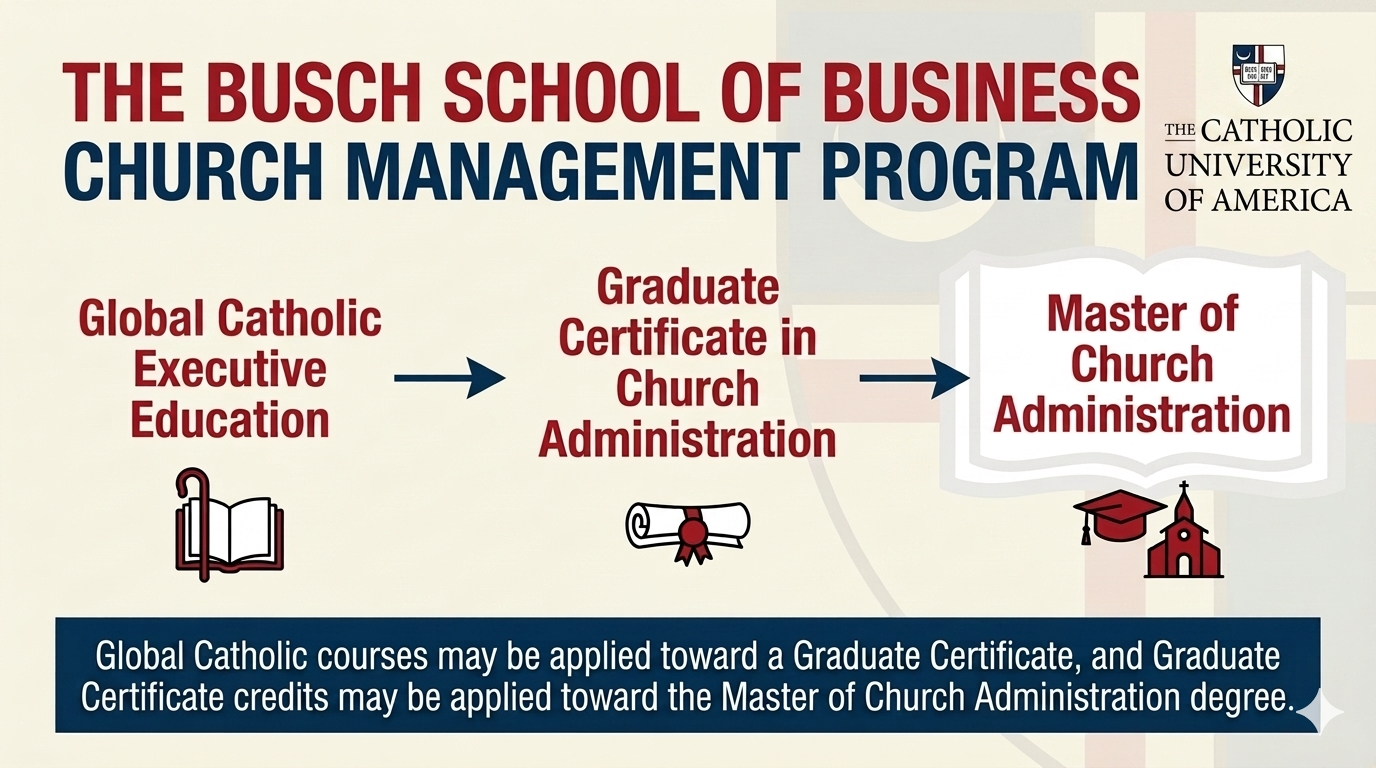
Lead the Church: Apply your credits toward a Master of Science in Church Management.

Solve a Problem: Take a self-paced non-credit course.
Stack Your Skills: Earn your Digital Badge and a tuition credit.
Lead the Church: Apply your tuition credits toward a MCA degree.

Well-formed seminarians make excellent pastors.



Is your parish facing financial hardship? We believe no priest should be denied formation due to budget. Click here to apply for a Parish Excellence Grant to your enrollment, or send an email to busch-cmp@cua.edu.

Most dioceses offer reimbursement for clergy ongoing formation of this kind. Contact your Vicar for Clergy to confirm this course applies to your diocesan policy. 

Online, asynchronous through Brightspace at The Catholic University of America.

No in-person or specific course days/times required.

Start and end when you want. 

This course is taught in English. Other languages are available upon request. Please email busch-cmp@cua.edu for more details.

Price: $447.00
Quantity: